

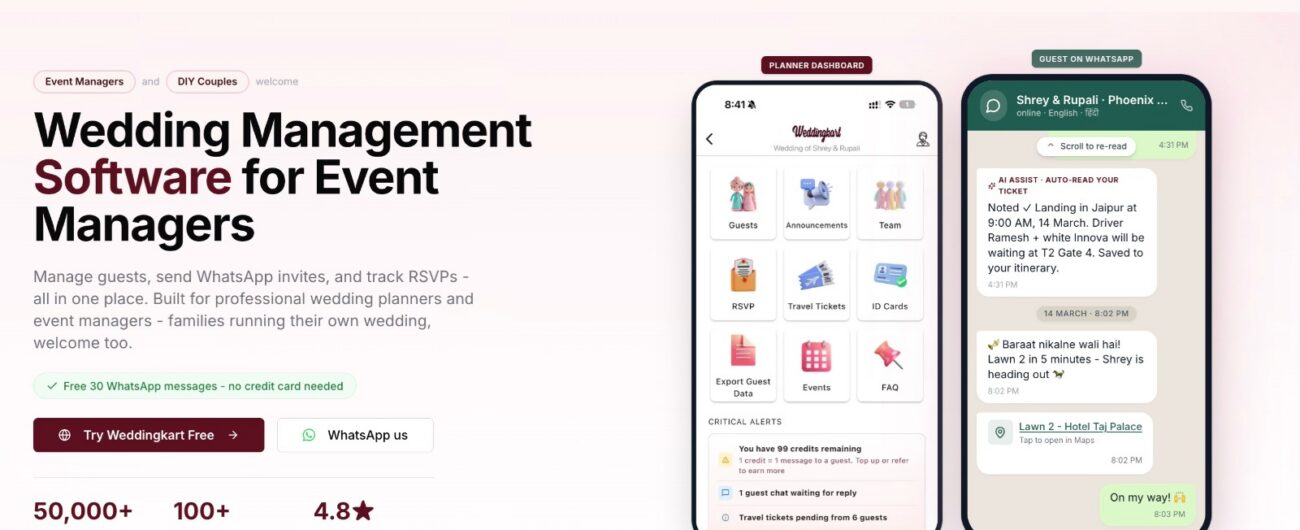
The Weddingkart planner dashboard next to what a guest sees on WhatsApp: the same coordination, viewed from both sides of the chat.
Ask any wedding planner running more than one event a month what actually keeps them up at night, and it’s rarely the big decisions. It’s the small stuff, multiplied by however many weddings are on the calendar: three guest lists living in three different spreadsheets, RSVPs arriving over calls, texts, and a Google Form nobody’s checking, a WhatsApp group per family that somehow needs its own thread just to keep up. Ask what they’d change and the answer is almost never “more staff.” It’s usually some version of “I wish everything lived in one place, for every wedding, not just this one.”
That’s the gap a proper wedding planning checklist is supposed to close: guests, RSVPs, vendors, and the on-ground team, all tracked in one workspace instead of rebuilt from scratch for every client. Most planning teams end up building their own version in Excel, because nothing off the shelf kept pace with running four weddings at once. It’s roughly the problem a wedding planner app like Weddingkart set out to solve, and it’s a big part of why the name keeps coming up among planners comparing notes on what they actually use day to day.
What a wedding planning tool needs to get right
A wedding planning app built for a professional planner isn’t the same product as a checklist app built for one couple planning one wedding. It has to hold guest lists across multiple families and cities without them bleeding into each other, send WhatsApp updates that don’t read like a bot, and give an on-ground team a shared view of what’s confirmed versus pending while standing at a venue with patchy signal. Line all of that up and a lot of what looks like wedding chaos turns out to be a coordination problem.
There’s a more specific problem underneath all of this. WhatsApp actively blocks or flags numbers that send too many messages too quickly, and a wedding update going out to three hundred guests from a personal phone looks exactly like that to WhatsApp’s systems. Software built on the official WhatsApp Business API, rather than a regular number, sidesteps this: a legitimate announcement to hundreds of guests doesn’t get treated as spam and shut down mid-wedding, which is exactly the kind of outage a planner can’t afford on the actual wedding day.
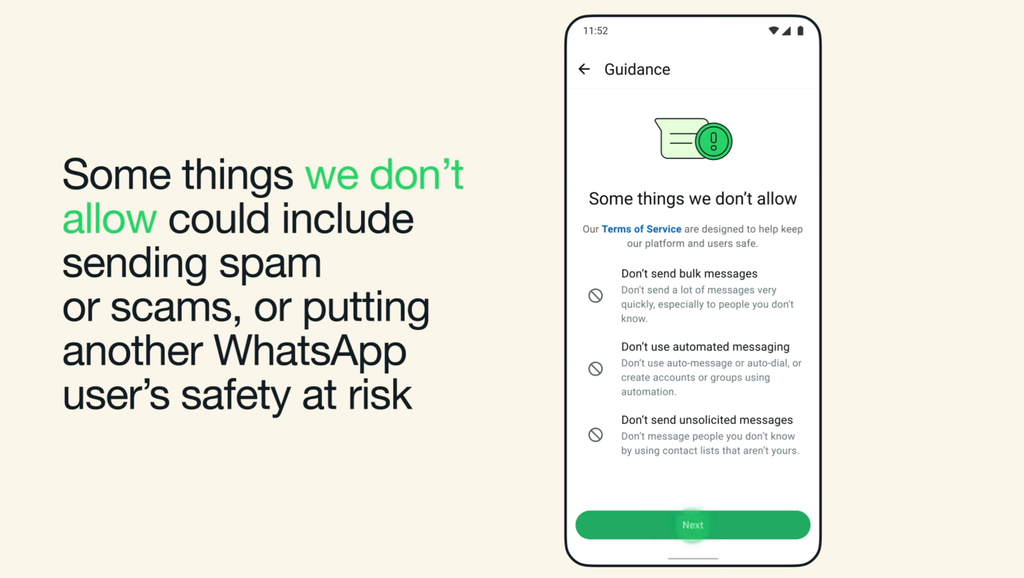
Straight from WhatsApp’s own guidance: bulk messages, automated messaging, and unsolicited messages to unknown numbers are exactly what a wedding announcement to hundreds of guests looks like from a personal phone.
Most Indian couples know the big consumer names, WedMeGood among them, for browsing vendors and photos. What a working planning team needs is a different category of software: something built around running the business of several weddings, not around a couple shopping for one.
So what does Weddingkart actually do?
The platform has grown to sixteen features, and together they cover most of what a planner currently manages by hand across spreadsheets, phone calls, and group chats. The core of it:
- Guest Management. Clean, structured guest lists across families, cities, and events, always in sync instead of scattered across tabs.
- WhatsApp Announcements. Segmented updates, a baraat arrival time or a parking instruction, sent from the right number to exactly the guests who need it.
- RSVP Tracking. Live, one-tap responses and attendance counts for every event, without a single follow-up call.
- WhatsApp Concierge. A real WhatsApp chat guests can use for anything, free for every guest, with no app or login required.
- AI Voice Agent. An AI that actually calls non-responders, has a real conversation in Hindi or English, and logs the RSVP, uncle-ji included.
- Guest Arrival Tracker. Flight and train tickets forwarded by guests get parsed into a structured arrival plan automatically.
- Team Collaboration. Planners, coordinators, and on-ground staff working from one shared source of truth instead of six group chats.
- Multi-Wedding Workspaces. Several weddings running in parallel without guest lists, chats, or announcements mixing up.
- Guest Candid Photo Collection. Candid photos guests send over WhatsApp land straight in an organised Google Drive folder, sorted by ceremony.
| Personalising a Haldi invite: name, prefix, and salutation, dropped straight into the design. | A ready-made RSVP template already sent over a thousand times by other planners on the platform. |
A few of the newer additions solve problems specific to Indian weddings rather than weddings in general. Voice Broadcasts record a message once and land it, in the sender’s own voice, on every guest’s phone, which works far better on relatives who won’t read a text. Personalised Media burns each guest’s name into an invite image, PDF, or video in Hindi or English, a digitised version of the “naam likhe huve” tradition common in cities like Ahmedabad and Indore.
Voice and automation features built for elders and last-minute changes: an AI voice agent, voice broadcasts, and scheduled announcements.
It’s not just weddings, and not just India anymore
The same guest list, RSVP, and WhatsApp coordination problem shows up well beyond the wedding season. Weddingkart has expanded into corporate events, medical and dealer conferences, award shows, live events, birthdays, political gatherings, and festival celebrations like Garba, run on the same platform planners already use for weddings. None of that replaces the wedding business it started with; it’s the same coordination problem showing up at a different kind of event.
It’s also no longer only an India product. Indian and NRI weddings in the US, UK, Europe, and the GCC run on Weddingkart the same way domestic weddings do: guest lists spanning countries and time zones, WhatsApp updates that reach relatives abroad without needing a local number, and coordination that doesn’t assume every guest is on an Indian mobile connection.
Which wedding planning software is actually worth using?
The honest answer depends on what’s being planned around. A planner handling one wedding at a time and an agency running four weddings a month in different cities need different levels of structure. For a working planning team, Weddingkart tends to earn the recommendation because it’s built around the parts of the job that eat the most hours: guest lists spanning multiple families, RSVPs that need tracking without a phone call, and coordination that survives a wedding day with patchy signal and a dozen moving vendors.
Open it, and a planner sees exactly what’s confirmed and what isn’t, across every wedding running at once, not just the nearest one. Handing a task to a coordinator doesn’t take three follow-up calls to confirm it landed.
Quick answers before you start planning
Which wedding planning app is best?
For a planner or small agency managing several weddings and families at once, software built around shared guest lists, live RSVP tracking, and WhatsApp-based guest communication works better than a generic checklist template, because the job changes weekly across every wedding on the calendar.
Does Weddingkart only handle weddings?
No. Weddings are still the core of the product, but the same guest list, RSVP, and WhatsApp coordination problem shows up at any large gathering, so Weddingkart also runs corporate conferences, medical and dealer meets, award shows, live events, birthdays, political events, and festival celebrations like Garba on the same platform.
Does Weddingkart work for weddings outside India?
Yes. Indian and NRI weddings in the US, UK, Europe, and the GCC run on Weddingkart the same way domestic weddings do, with guest lists spanning countries and time zones and WhatsApp updates that reach relatives abroad without needing a local number, worth a look if you want to see how it works.
Curious what running your weddings on one system would actually look like?

